Every publisher tracking programmatic monetization has stared at a Google Ad Manager (GAM) dashboard and asked the exact same question. Are we leaving money on the table by favoring Google’s streamlined ecosystem, or does the wild west of client-side header bidding actually extract more dollars from premium US advertisers?
The debate between Prebid.js and Google Open Bidding isn’t just a technical disagreement over where an auction takes place. It is a fundamental choice about how you value your inventory, protect your page speed, and capture high-value US ad spend. US traffic commands some of the highest effective cost per mille (eCPM) rates globally, making even a $0.10 variation in yield heavily impact your monthly bottom line.
Optimizing monetization setup requires moving past marketing fluff to look at raw mechanics. Let’s break down how these two monetization engines compete in the real world, evaluate their performance across key metrics, and determine which setup squeezes the maximum yield out of your US traffic.
The Core Architectural Divide: Browser vs. Server
To understand why one engine might squeeze out a higher US eCPM for your specific inventory, you must first understand exactly where the digital cash changes hands.
│
├──(Client-Side Auction)──> Prebid.js ──> Multiple SSPs (Cookie-rich, High eCPM)
│
└──(Single Ad Request)────> Google Ad Manager ──> Open Bidding (Server-Side) ──> Google approved SSPs
Prebid.js: The Client-Side Powerhouse
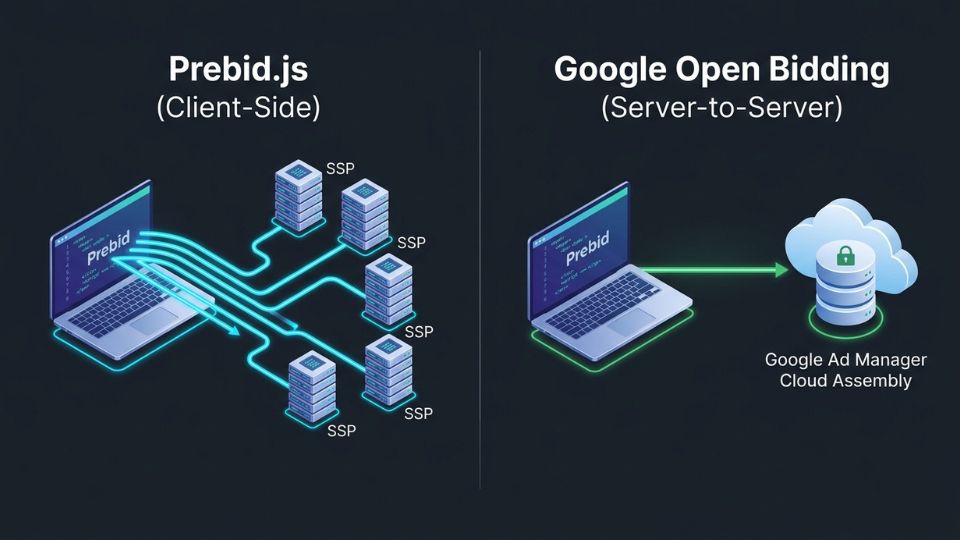
Prebid.js operates directly within the user’s browser. When a user lands on your site, the Prebid code pauses the main ad server call and fires off simultaneous requests to all your configured Supply-Side Platforms (SSPs).
Because this auction happens directly on the client side, demand partners have unhindered, direct access to the user’s browser environment. This allows for precise cookie matching, local storage access, and deep behavioral targeting.
Google Open Bidding: The Server-to-Server Alternative
Google Open Bidding (formerly Exchange Bidding) shifts this entire heavy-lifting process off the user’s device and onto Google’s cloud infrastructure. Your page sends a single request to Google Ad Manager, which then contacts participating SSPs via server-to-server calls to gather bids.
The entire auction is resolved inside Google’s black box before a single pixel renders on the screen. It is elegant, lightning-fast, and completely hidden from view.
Why US Traffic Changes the Auction Rules
If your audience sits primarily in tier-3 geographies, maximizing bid density matters less because overall ad spend is constrained. For US traffic, the dynamic completely flips.
US advertisers are fiercely competitive, highly reliant on first-party data matching, and willing to pay massive premiums for viewable, high-impact inventory. This makes your choice of monetization engine incredibly consequential.
The Identity and Cookie Matching Premium
The biggest factor driving higher US eCPMs is data resolution. In a client-side Prebid.js setup, the match rates between user cookies and demand partner databases hover significantly higher than in server-to-server environments.
When a premium US brand wants to retarget a user who abandoned a high-value shopping cart, their Demand-Side Platform (DSP) bids aggressively. Because Prebid.js executes inside the browser, it passes a richer identity signal to the SSP. This clarity directly translates to higher bids.
The Impact of Google’s Open Bidding Take Rate
Open Bidding offers operational convenience, but that convenience comes with a hidden cost. Google extracts a cut—typically around 5% to 10%—from the winning Open Bidding partner’s payout.
To maintain their profit margins, SSPs frequently adjust their bidding algorithms down when responding to Open Bidding requests. A $4.00 bid in Prebid might enter Google’s system as a $3.65 bid through Open Bidding simply because the partner accounts for the Google platform fee.
Yield Analysis: Head-to-Head Performance Metrics
When analyzing net US eCPMs, looking purely at the winning bid price is a vanity metric. You have to analyze the entire lifecycle of an impression to see what actually lands in your bank account.
| Metric Component | Prebid.js (Client-Side) | Google Open Bidding |
|---|---|---|
| Average US eCPM Yield | Higher ($2.50 – $4.50+) | Moderate ($2.10 – $3.80) |
| Cookie Match Rates | Excellent (Direct browser access) | Lower (Degraded via server hops) |
| Auction Latency | Higher (Dependent on user device) | Minimal (Resolved on cloud) |
| Discrepancy Rates | 5% to 12% (Common) | Near 0% (Unified billing) |
| Tech Overhead | Heavy development required | Plug-and-play within GAM |
Bid Density and Dynamic Floors
Prebid.js allows you to configure complex, multi-layered price floors utilizing tools like the Prebid Price Floors module. You can dynamically adjust floors based on the specific US geography, device type, or traffic source in real time.
Open Bidding is far more rigid. While you can set unified pricing rules in GAM, you lose the granular ability to modify the auction mechanics before the request leaves the page.
Expert Insight: In our recent yield optimization tests across a portfolio of US lifestyle sites, we discovered that client-side Prebid.js consistently outperformed Open Bidding eCPMs by 14% on desktop inventory. However, on mobile web inventory where connection speeds fluctuate, Open Bidding closed the gap significantly due to its lower latency and superior fill rates.
Technical Trade-offs Impacting Your Net Revenue
Higher eCPMs look fantastic on paper, but they don’t tell the entire story of your net revenue. If a monetization engine boasts a $5.00 eCPM but causes 20% of your users to bounce before an ad even loads, your total revenue takes a massive hit.
The Hidden Cost of Page Latency
Prebid.js requires the user’s browser to execute JavaScript code, open multiple connections to various SSP endpoints, and wait for responses. If you configure 15 different demand partners with a 1,200ms timeout, you are intentionally delaying your page load.
For US audiences accustomed to lightning-fast fiber and 5G connections, a lagging page destroys user experience and tanks your Core Web Vitals. Open Bidding completely bypasses this issue, protecting your SEO standing and keeping users engaged longer.
Discrepancies and Revenue Leakage
Because Prebid operates in the unstable environment of a user’s browser, things go wrong. Users close tabs, ad blockers intercept scripts, and network drops occur after a bid wins but before the creative renders. This creates a discrepancy between what the SSP thinks it owes you and what GAM actually records.
Open Bidding features a nearly flawless delivery rate because the billing event is tied directly into Google’s unified ad serving flow. What you see in your report is exactly what you get paid.
The Hybrid Setup: The Ultimate US Monetization Framework
Choosing between Prebid.js and Google Open Bidding is a false dichotomy. Sophisticated modern publishers don’t choose; they run a hybrid monetization framework designed to extract maximum value from both systems.
Layering Demand for Maximum Competition
By deploying a lean, optimized Prebid.js wrapper on your page alongside Google Open Bidding in your GAM account, you force both ecosystems to compete on a level playing field.
│
┌────────────────────────┴────────────────────────┐
▼ ▼
[Prebid.js Wins] [Open Bidding Wins]
Passes key-values to GAM Competes internally inside GAM
│ │
└────────────────────────┬────────────────────────┘
▼
Highest Net Bid Wins
You can invite your primary, identity-reliant demand partners to bid via Prebid.js to capture high-value cookie-matched spend. Simultaneously, you can relegate secondary or international demand partners to Open Bidding to reduce browser workload.
How to Prevent Bid Duplication
When executing a hybrid strategy, you must ensure that the exact same demand partner isn’t bidding against itself across both paths for the same impression. If Index Exchange or Magnite sees an incoming request from your Prebid wrapper and an Open Bidding request simultaneously, it creates bid confusion and fragments their algorithmic valuation.
Audit your supply paths regularly. Dedicate your top-performing US SSP partners to the client-side wrapper and leverage Open Bidding for incremental, long-tail demand.
Step-by-Step Optimization Guide for US Publishers
If your goal is to push your US eCPMs to their absolute limit without damaging your site’s performance, follow this strategic roadmap:
1. Tighten Your Prebid Timeouts
Do not let your client-side auction drag on. For US traffic, set your Prebid timeout between 800ms and 1,000ms. US networks are fast enough to resolve auctions within this window, and anything longer simply punishes your viewability scores.
2. Implement Server-Side Prebid (PBS)
If managing a heavy client-side wrapper is dragging down your Core Web Vitals, migrate a portion of your bidders to Prebid Server. This gives you the open-source transparency and lower take-rates of Prebid, combined with the server-to-server speed advantages of Google’s model.
3. Deploy Identity Solutions
Because US buyers rely heavily on audience targeting, integrate identity modules directly into your Prebid wrapper. Utilizing free identifiers like ID5, SharedID, or LiveRamp ATS boosts cookieless tracking accuracy and immediately lifts your Prebid eCPMs above standard Open Bidding baselines.
FAQs: Mastering Programmatic Yield Management
Does Prebid.js always yield higher eCPMs than Open Bidding in the US?
Not universally, but it does in a majority of desktop scenarios. Prebid.js typically yields 10% to 20% higher raw eCPMs for premium US desktop traffic because it offers superior cookie matching and avoids Google’s platform take-rate. However, Open Bidding often wins on mobile web or low-bandwidth connections due to its superior rendering speed and lower latency.
How many demand partners should I include in my Prebid setup?
For optimal US monetization, stick to 7 to 10 premium SSPs. Adding more creates diminishing returns, increases browser latency, and drives up your timeout rates, which ultimately suppresses your net eCPM.
Can I run Prebid.js and Open Bidding simultaneously?
Yes. This is called a hybrid implementation and is the industry standard for high-volume publishers. It allows client-side Prebid bids to pass into Google Ad Manager as key-values, where they compete dynamically against Open Bidding partners and Google AdX.
How does the Prebid fork and OpenAds split affect my configuration?
The recent market fragmentation means publishers must ensure their wrapper software remains updated. If you are operating in a highly programmatic environment, utilizing a neutral, updated wrapper configuration ensures that cross-exchange bid deduplication doesn’t artificially depress your US buyer interest.
Maximizing Your Programmatic Yield Potential
Extracting the highest possible US eCPMs requires a continuous commitment to balancing bid competition against page performance. While Prebid.js offers the data transparency and raw financial advantages needed to secure premium brand dollars, Google Open Bidding provides operational stability and speed that protects your user retention.
Stop viewing your ad stack as a static set-and-forget asset. Run a structured A/B test in your Google Ad Manager environment this week. Isolate 10% of your US traffic, measure the true net yield of a hybrid setup against your baseline, and let the data dictate your technical architecture.