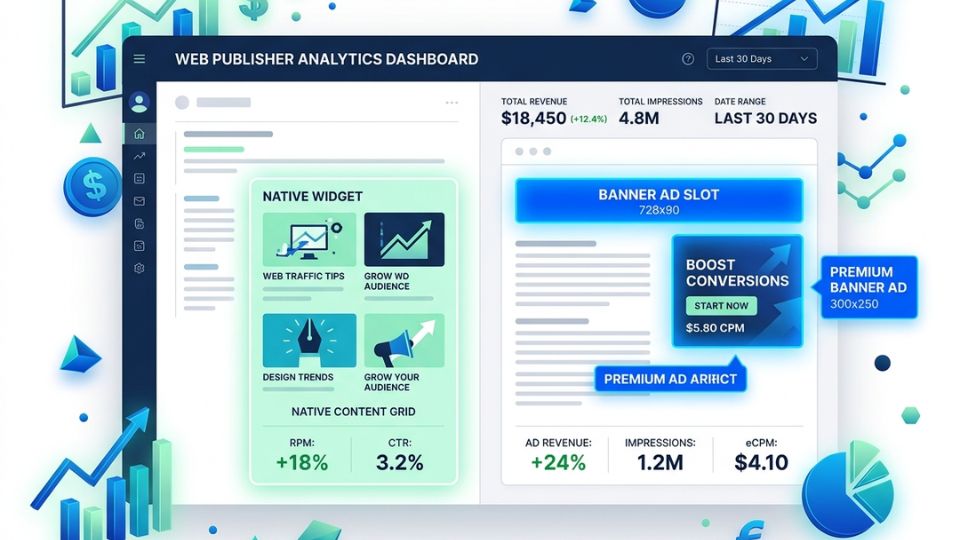
You are leaving money on the table. Every day, thousands of publishers look at their programmatic dashboards and sigh at stagnant eCPMs. The traditional solution? Slap another banner ad on the sidebar and pray for a lift in revenue.
But that old-school playbook is broken. Today’s audiences in the USA have developed intense banner blindness, and aggressive ad placements just drive them straight to ad-blockers. If you want to squeeze maximum yield out of your traffic, you have to get smarter.
The real secret lies in orchestration. By strategically combining native widgets with traditional banner ads, you can create a high-yield ecosystem where both formats complement, rather than cannibalize, one another. Let’s dive into how you can pull this off seamlessly.
—
The Mechanics of Hybrid Monetization
To win this game, you must understand how these two formats interact. Banner ads are great for instant, high-impact visibility, especially when premium US advertisers are bidding for top-of-the-page inventory. Native widgets, on the other hand, mimic the form and function of your editorial content, capturing deep user engagement further down the page.
When you combine them properly, you target two distinct user behaviors. Some users naturally ignore banners but readily click on recommended content feeds. Others are caught by the bold visuals of a premium display unit. It’s about building a net that catches every type of visitor.
Understanding the Demand Sources
Banners rely heavily on standard OpenRTB programmatic auctions. Native widgets often pull from content recommendation networks like Taboola, Outbrain, or specialized mid-market native providers. By running both, you instantly diversify your demand partners, forcing advertisers to bid higher across the board.
The Math Behind Combined Yield
Maximum yield isn’t just about the highest individual eCPM; it’s about total Page RPM. If a banner gives you a $3.00 eCPM and a native widget adds another $4.50, your combined page profitability skyrockets. You are essentially monetization-stacking without overwhelming the layout.
—
Step-by-Step Blueprint for Ad Placement Orchestration
Layout architecture dictates your financial success. If you crowd your widgets and banners together, your viewability scores will plummet, causing Google AdSense or your header bidding partners to penalize your inventory. Space, timing, and contrast are everything.
Start with a clean slate. We recommend mapping out your layout based on the user’s natural scrolling journey down the page.
Here is a battle-tested blueprint that consistently crushes performance metrics for US traffic:
| Page Zone | Ad Format Type | Primary Optimization Goal |
|---|---|---|
| Above the Fold (ATF) | Premium Sticky Banner (728×90 or 970×250) | High Viewability & Immediate Impressions |
| Mid-Article (In-Content) | Alternating Native In-Feed Units & Inline Banners | High Click-Through Rate (CTR) & Contextual Relevance |
| Sidebar (Desktop Only) | 300×600 Sticky Banner | Maximum Dwell Time & Continuous Exposure |
| Below the Fold (BTF) | 4×2 Content Recommendation Native Widget | Post-Read Engagement & Native Widget Ad Monetization |
Perfecting the Above-The-Fold Real Estate
Keep native widgets away from the very top of your site. Users expect immediate value when they arrive, so an above-the-fold native widget looks like spam. Instead, use a clean, high-paying display banner here to grab premium programmatic dollars immediately.
Mastering the Mid-Article Flow
This is where things get interesting. As users read, inject a native ad unit that matches your font and styling, followed a few paragraphs later by a standard display rectangle. This alternating pattern resets the user’s visual attention, breaking through banner blindness effectively.
Winning the Below-The-Fold Close
Once a reader finishes an article, they ask themselves, “What next?” This is prime real estate for a massive native recommendation widget. Pack it with a mix of internal sponsored content and external high-CPC offers to capture that high-intent exit traffic.
—
Optimizing Core Web Vitals and User Experience
Nothing kills ad yield faster than a slow website. Google’s algorithms ruthlessly penalize sluggish sites in the search rankings, which destroys your organic traffic flow. Heavy ad scripts from multiple networks are the usual suspects here.
You cannot simply throw codes onto your site and hope for the best. Code optimization is just as critical as your placement strategy.
During a recent optimization audit for a lifestyle publisher client, we noticed their Cumulative Layout Shift (CLS) was in the red. The culprit? Native widgets loading dynamically and pushing the content down. Fixing this single issue caused an immediate 14% lift in programmatic revenue because users stopped bouncing in frustration.
Taming Cumulative Layout Shift (CLS)
Always reserve hardcoded CSS slots for both your banners and your native widgets. If a native widget requires 400px of vertical space, define that space in your stylesheet beforehand. This ensures the page layout remains rock-solid while the ad creative loads quietly in the background.
Implementing Lazy Loading Strategically
Do not load your below-the-fold native widgets until the user is at least 50% of the way down the page. Lazy loading saves precious browser bandwidth, improves your Largest Contentful Paint (LCP), and keeps your site feeling lightning-fast.
—
Advanced Yield Management and A/B Testing
Set-and-forget is a losing strategy in programmatic advertising. The US ad market fluctuates constantly based on seasonality, browser privacy updates, and advertiser budgets. To maintain peak performance, you need a rigorous testing framework.
Data must guide every single layout change you make. Let’s look at how you can set up a sophisticated testing loop to consistently grow your RPMs.
Setting Up Segmented Dynamic Pricing
Configure your header bidding wrapper to pass distinct key-values to your ad server. This allows you to serve different combinations to a desktop user in California versus a mobile user in New York. Maximize your programmatic yield strategy by targeting high-value geos with premium, high-density layouts.
The Power of A/B Testing Placements
Run a split test where Group A sees a standard layout and Group B sees a native widget integrated directly into the sidebar alongside a sticky banner. Run the test for at least two weeks or until you hit statistical significance. You might find that the hybrid sidebar completely outperforms the traditional setup.
Expert Tip: Keep a close eye on your bounce rate during these tests. A layout that increases ad yield by 5% but increases your bounce rate by 15% is a net loss for your brand’s long-term health and organic reach.
—
Navigating Compliance and Network Policies
Making money means nothing if your account gets banned. Major networks, especially Google, have strict guidelines regarding ad density and labeling. Violating these rules will quickly land you in the publisher penalty box.
Transparency builds long-term value. Your users and your network partners need to clearly understand what is editorial content and what is paid promotion.
Decoding Google Publisher Policies
Google requires clear separation between content and ads. Ensure your native widgets are explicitly labeled with terms like “Sponsored Content,” “Promoted Stories,” or “Ad.” Never style a native widget to trick users into accidental clicks, as this will trigger invalid traffic (IVT) flags.
Managing Ad Density Ratios
According to the Coalition for Better Ads, your total ad real estate should never exceed 30% of the vertical page space on mobile screens. Keep your copy substantial and use your native widgets and banners as crisp accents rather than a suffocating wall of monetization.
—
Frequently Asked Questions
Will running native widgets lower my banner ad CTR?
No, when implemented correctly, they actually help. Because native widgets blend into the content stream, they don’t trigger the same psychological resistance as banners. This layout balance keeps users engaged on the page longer, which frequently improves your banner viewability and overall CTR.
What is a good eCPM for US traffic using a hybrid layout?
For US-based traffic, desktop hybrid layouts can easily see combined Page RPMs ranging from $15.00 to $45.00+, depending heavily on your niche. Finance, tech, and automotive niches generally command much higher CPCs and programmatic bids than general news or entertainment.
Should I use the same network for both banners and native units?
Generally, it is better to diversify. Use specialized programmatic SSPs (like Google Ad Exchange, Magnite, or PubMatic) for your banner inventory, and partner with dedicated native platforms for your recommendation widgets. This setup maximizes auction pressure and optimization potential.
—
Take Your Ad Revenue to the Next Level
Balancing user experience with maximum ad yield doesn’t have to be a guessing game. By introducing a deliberate strategy that pairs high-impact banners above the fold with deeply engaging native widgets in your content streams, you unlock hidden revenue potential without alienating your core audience.
Stop settling for mediocre monetization metrics. Take a hard look at your current layout today, identify where you can introduce alternating ad formats, and start running your first optimization split test this week.
Want more insider monetization frameworks? Sign up for our Advlume newsletter to get premium optimization strategies delivered straight to your inbox.